10 Questions Every Business Should Ask About Risk

Your Business Has Changed. Has Your Risk Profile? 10 Questions to Ask Before Fall
Think about your business at the beginning of this year.
Now think about your business today.
Have you hired employees? Purchased equipment? Added a vehicle? Signed a larger contract? Started using new technology? Increased revenue? Changed vendors?
For many small businesses, the answer to at least one of those questions is yes.
The problem is that insurance policies don't automatically understand how your business has changed.
That's why a strong insurance strategy shouldn't begin with, "Can I get a better premium?"
It should begin with, "What has changed in my business, and what new risks have those changes created?"
Before heading into the final months of the year, here are 10 questions every business owner should ask.
1. Has Our Revenue Increased?
Growth is good, but increased revenue can also indicate increased exposure.
More sales may mean more customers, larger projects, additional inventory, or greater contractual obligations.
If your business is significantly larger than it was when your policy began, your insurance program deserves another look.
2. Have We Hired or Changed Employees?
New employees can affect workers' compensation, payroll estimates, employment practices liability, commercial auto exposure, and other areas.
Don't only count employees.
Ask whether their responsibilities have changed too.
An employee who moved from administrative duties into field work may create a very different exposure.
3. Have We Purchased Equipment or Increased Inventory?
Businesses constantly invest in themselves.
Computers, machinery, tools, furniture, inventory, and specialized equipment can add significant value throughout the year.
Ask yourself:
If we lost everything tonight, would the property limits on our current policy realistically replace what we own today?
4. Have We Added Vehicles or Changed How Employees Drive?
Commercial auto risk isn't limited to businesses with large fleets.
Company vehicles, delivery routes, employees traveling between locations, and workers using personal vehicles for company errands can all create exposures.
Review who drives, what they drive, how often they drive, and why.
5. Are We Working With New Subcontractors?
Hiring subcontractors can transfer some work—but it doesn't automatically transfer all the risk.
Review your subcontractor agreements, Certificates of Insurance, coverage requirements, and documentation procedures.
A COI should be part of your risk-management process, not the entire process.
6. Are We Signing Larger or Different Contracts?
A new customer or project can introduce insurance requirements your current program wasn't designed to address.
Contracts may require higher liability limits, additional insured status, specific endorsements, or specialized coverage.
Review insurance requirements before signing whenever possible, rather than discovering a problem after work begins.
7. Has Our Technology Changed?
Maybe your team started using new cloud software, AI tools, online payment systems, customer databases, or remote-work technology.
Each new system can introduce additional cyber and privacy exposures.
Ask what information those systems access, who has permission to use them, and what would happen if they became unavailable.
8. Are We Too Dependent on One Vendor?
What happens if your most important supplier can't deliver for 30 days?
Or your primary technology provider experiences a major outage?
Your business may be physically unharmed and still unable to operate.
Identifying critical vendors and developing backup plans should be part of your business continuity strategy.
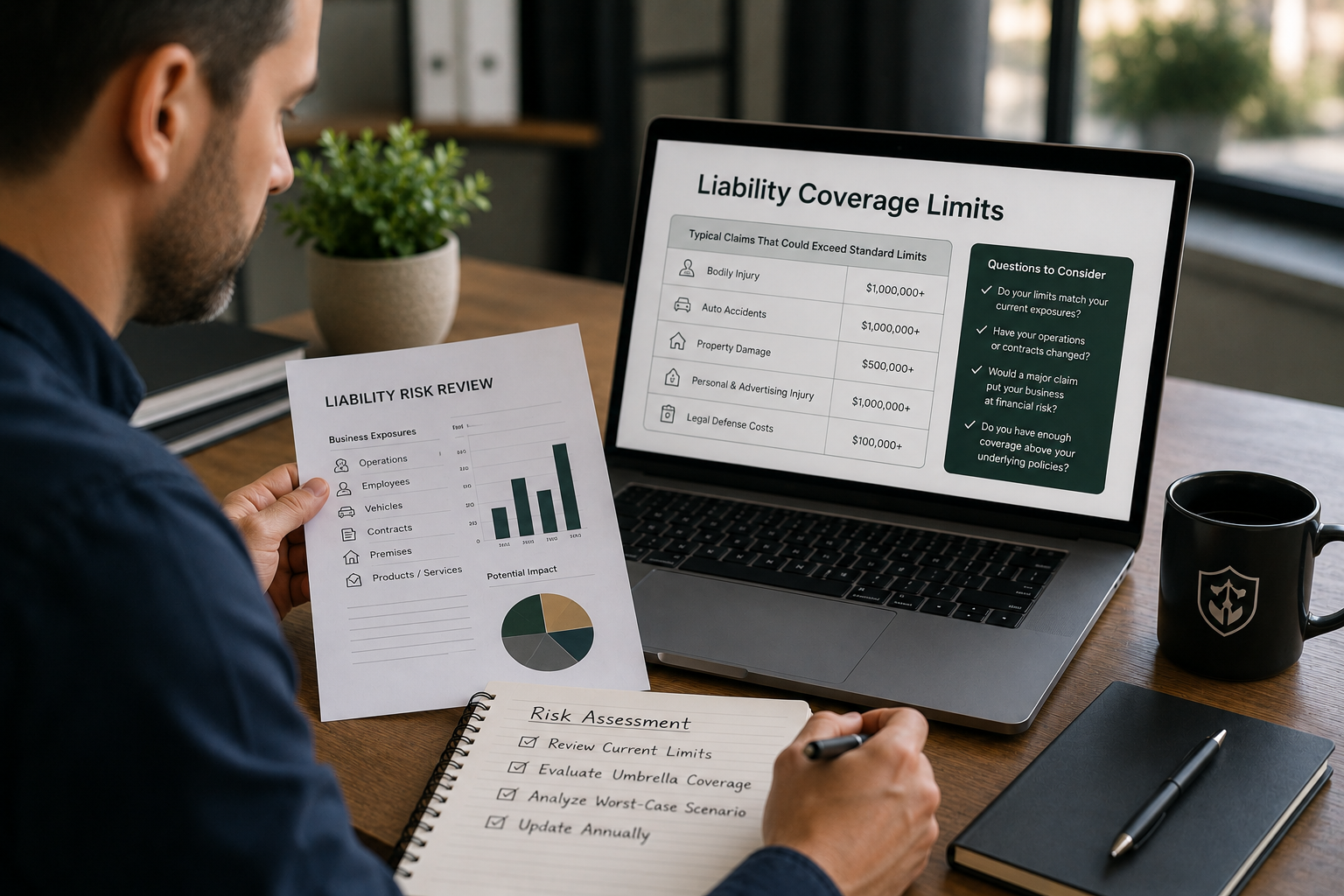
9. Could a Serious Claim Exceed Our Liability Limits?
Don't evaluate liability limits simply by looking at what you've always carried.
Consider your current operations.
More vehicles, employees, customers, locations, assets, and larger contracts may mean the financial severity of a potential claim has increased.
Commercial umbrella or excess liability coverage may be worth discussing as part of a broader risk assessment.
10. When Did Someone Last Review the Entire Picture?
This may be the most important question.
Business insurance is often divided into separate policies: property, general liability, workers' compensation, commercial auto, cyber, professional liability, umbrella, and others.
But your business doesn't operate in separate pieces.
A change in one area can affect several others.
That's why reviewing individual policies isn't always enough.
Someone needs to look at the entire risk profile.
A Risk Assessment Is More Than an Insurance Review
The purpose of a risk assessment isn't to find reasons to buy more insurance.
It's to understand where your business is vulnerable.
Some risks may require insurance.
Others may be better addressed through employee training, stronger contracts, cybersecurity controls, vehicle policies, vendor diversification, safety procedures, or business continuity planning.
Often, the best strategy involves a combination of both.
That's the difference between simply purchasing insurance and practicing proactive risk mitigation.
Don't Wait for Renewal to Ask Better Questions
Your insurance renewal may happen once a year.
Your business changes every day.
Before fall arrives, take 15 minutes and work through these 10 questions. If several answers have changed since your last insurance review, that's a good indication your risk profile has changed too.
Has Your Insurance Kept Up With Your Business?
You shouldn't have to wait for a claim to discover that an important change was never addressed.
Contact one of the Risk Advisors at Fortis Risk Group for a comprehensive policy and risk review. We'll take the time to understand how your business operates today, identify potential gaps and emerging exposures, and help build an insurance and risk-management strategy designed around the business you're becoming—not simply the business you used to be.
Latest insights and trends




Let’s Build Your Protection Strategy